1xBet Canada Payments: Interac Deposits and Withdrawals Guide
Canadian players who want to fund or cash out an online betting account usually run into the same practical question first: which payment methods actually work for a C$ balance held in a Canadian bank. Anyone searching for 1xBet Canada payment options in Toronto, Vancouver, or Montreal is really asking whether the cashier will accept their card or Interac login, how long money takes to arrive, and what it costs to move it in both directions. The answers depend less on the brand name and more on the provincial rules that govern online gambling, the bank that issues the card, and the specific cashier settings on the account. This article walks through those variables in detail so that a reader can plan a deposit and a withdrawal before committing any money.
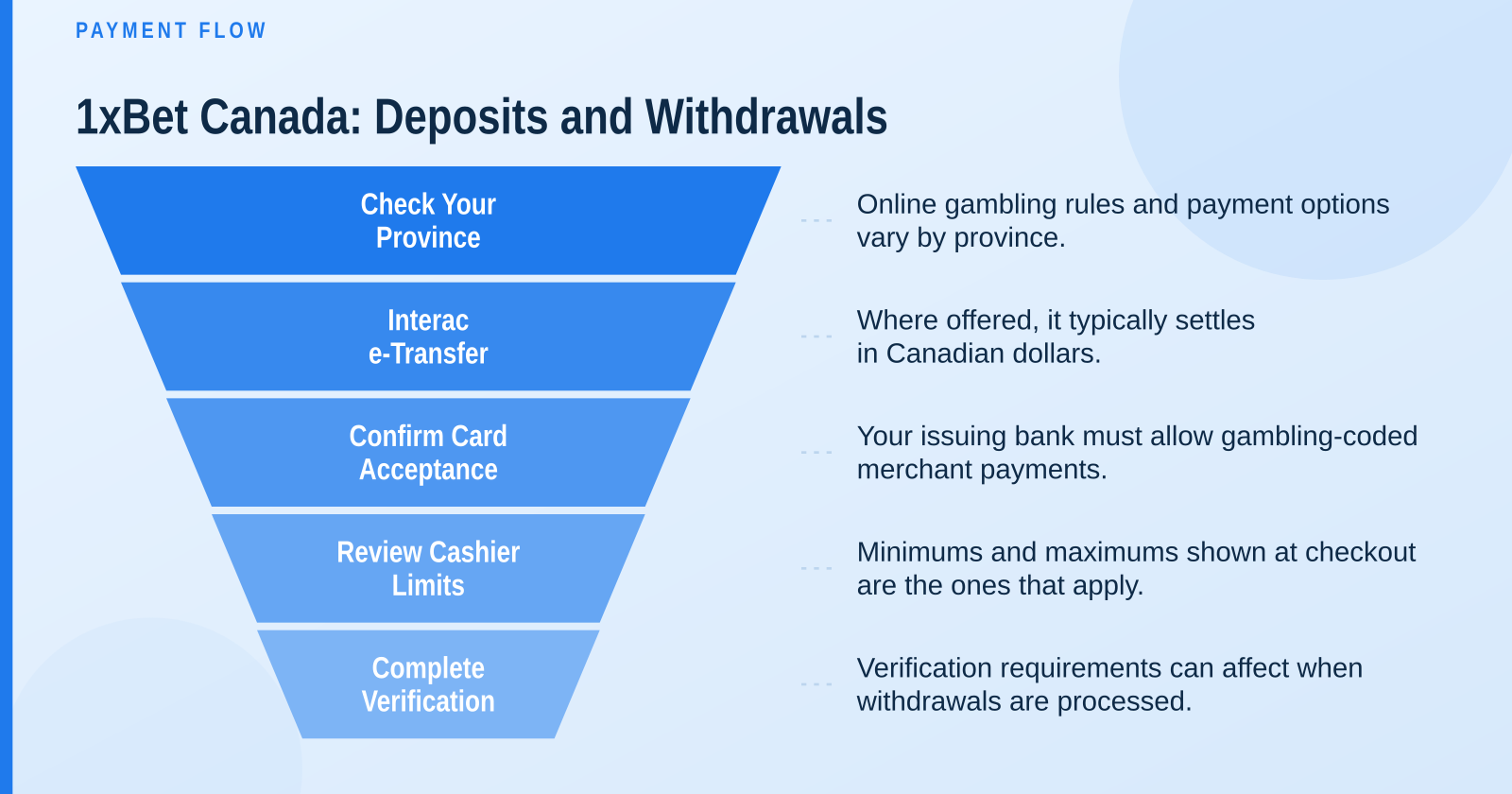
The starting point is understanding that payment availability in Canada is not uniform. Online gambling is regulated provincially, and Ontario operates its own iGaming framework, while other provinces follow different rules and sometimes different licensing arrangements. That means a method that is listed for a user in Toronto may not appear for someone in Calgary or Halifax, and the cashier may show a different set of options depending on the account's registered location. Before comparing options, a Canadian user should confirm the legal gambling age in their province, which varies, and should check the live cashier once logged in. The information published on the official page at 1xbet interac reflects that the supported methods change with account and location, so treat any list as a snapshot rather than a guarantee.
1xBet Canada Payment Methods: What the Cashier Typically Offers
The payment methods that Canadian users most often encounter fall into a few families: Interac e-Transfer, major card networks such as Visa and Mastercard, supported cryptocurrency options, and the payment limits displayed inside the cashier. Each family works differently at the bank level, which is why the same deposit amount can clear in minutes through one route and take several business days through another. Understanding the mechanics of each family is more useful than memorizing a menu, because the menu itself is subject to change.
For a Canadian account, the cashier should be treated as the authoritative source for what is available at any given moment. Methods can be added, paused, or restricted for a specific account, and the displayed minimums and maximums are the ones that will apply at checkout. A careful user checks three things before depositing: whether the method is offered in C$, what the minimum and maximum per transaction are, and whether any fee or conversion step is shown. Skipping those checks is the most common reason people end up with a deposit that is smaller than they expected or a payment that has been routed through an unfamiliar currency.
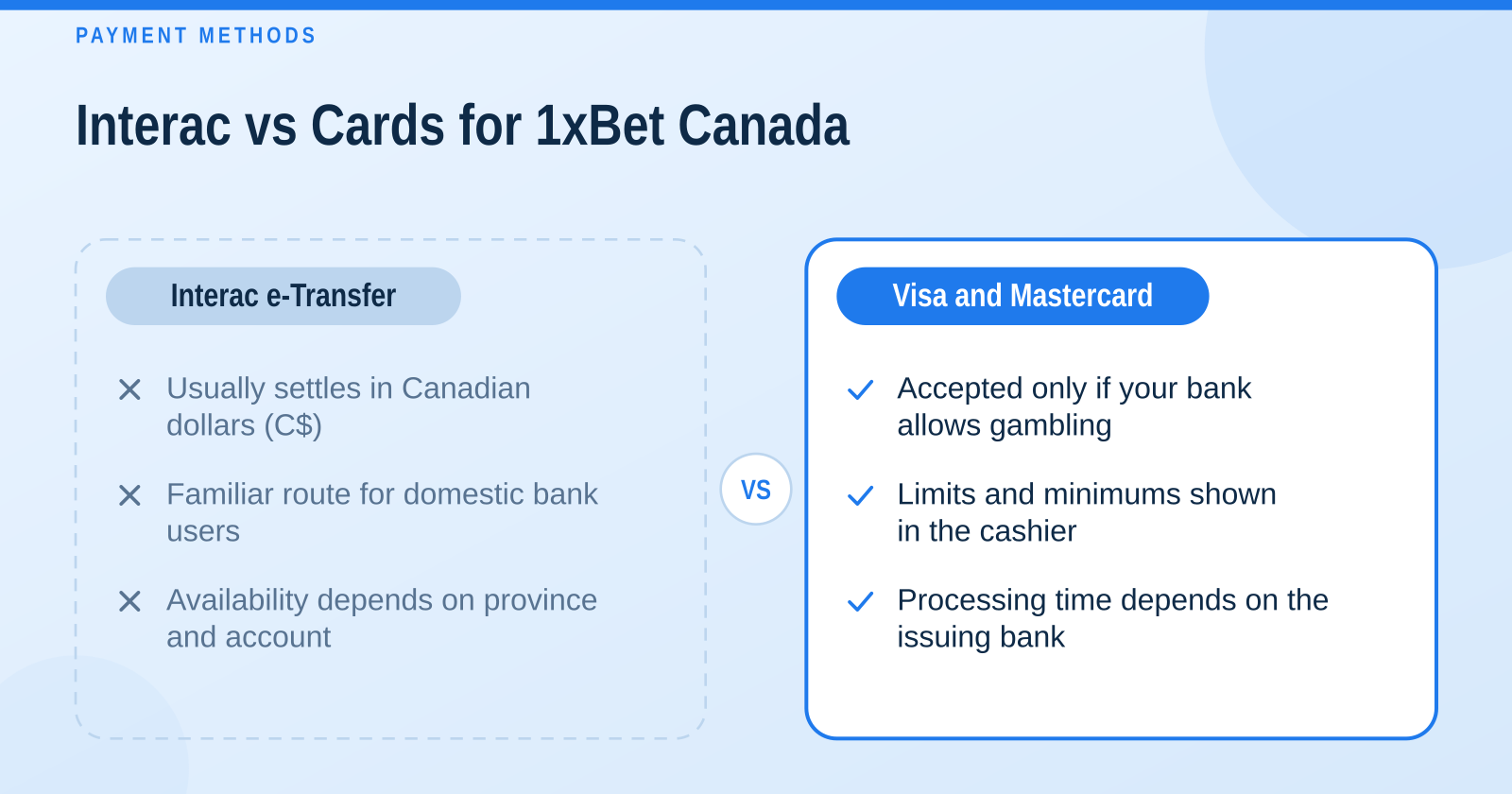
- Interac e-Transfer, where it is offered, typically settles in Canadian dollars and is the most familiar route for domestic users.
- Visa and Mastercard cards, where accepted, depend on the issuing bank's willingness to process gambling-coded merchant transactions.
- Supported cryptocurrency options introduce network fees and exchange-rate exposure that do not exist with fiat rails.
- Limits shown in the cashier override any general figure you may have read elsewhere, so the cashier is the final reference.
Interac e-Transfer as a Canadian Payment Rail
Interac e-Transfer is the payment method that most Canadians recognize from paying friends, landlords, and small businesses, and it is the reason many domestic users expect a betting deposit to work the same way. Where it is available, the transfer is initiated from an online banking session, authorized by the user's own bank, and credited to the destination account. Because the money moves between Canadian financial institutions in Canadian dollars, there is no currency conversion step and no foreign transaction fee on the deposit side. That combination of speed and simplicity is why Interac is usually the first option a local user looks for.
Availability is the complicating factor. Interac e-Transfer may be offered only to eligible accounts, and the minimum amount, the per-transaction limit, and the daily or monthly ceiling can differ from one account to another. A user in Vancouver who has just opened an account may see a lower limit than an established user, and that difference is normal rather than a sign of a problem. It is also worth remembering that Interac Online, an older bank-login variant, has been phased out by several banks, so a user whose bank no longer supports it should look at e-Transfer or cards instead of assuming the old route still works.
Planning around Interac limits is a practical exercise. If the cashier shows a per-transaction cap of, for example, a few hundred dollars, a user who wants to fund a larger bankroll will need to split the deposit across several transactions, and the timing of each one matters. Banks also impose their own daily transfer limits, which can be lower than the cashier limit, so the effective ceiling is whichever number is smaller. Checking both before a session saves the frustration of a declined transfer halfway through an intended top-up.
The effective deposit ceiling is the lower of two numbers: the limit set by the betting cashier and the limit set by your own bank. Plan around the smaller one.
Card Deposits and How Canadian Issuers Respond
Cards remain a widely used option, and the experience depends heavily on which bank issued the card. Big Canadian institutions such as RBC, TD, Scotiabank, BMO, and CIBC each apply their own rules for merchant category codes, and some have historically blocked or flagged gambling transactions by default. A transaction can be declined without any obvious reason to the user, because the decline comes from the issuer's fraud or policy filter rather than from the cashier. This is why two people with identical accounts can have very different outcomes when they try the same card.
Credit and debit cards behave differently as well. A credit card transaction creates a cash-advance-like charge in some issuers' systems, which can carry a higher interest rate and fees, while a debit card draws directly from the chequing balance. Users who rely on a credit line should check their card agreement to see how gambling merchants are classified, because the cost of a deposit can be meaningfully higher than the nominal amount. A debit card is often the simpler choice for controlling spending, though it still requires the bank to approve the merchant category.
Currency is the third factor. If the card is denominated in C$ and the cashier charges in C$, the transaction is straightforward. If the cashier or the card network applies a conversion, the user may see a foreign transaction fee and an exchange rate that differs from the mid-market rate. The effective cost of a card deposit is therefore the amount charged plus any issuer fee and any spread, and it is the number that should be compared against other methods rather than the headline deposit figure.
- Check whether your issuer blocks gambling merchant codes before relying on a card.
- Distinguish credit from debit, because the cost structure and the interest treatment differ.
- Confirm that the transaction is in C$ to avoid conversion fees.
- If a card is declined, contact the issuer rather than repeatedly retrying, since repeated attempts can trigger additional fraud holds.
E-Wallets, Cryptocurrency, and Direct Bank Transfers
Beyond Interac and cards, the cashier may list e-wallets, cryptocurrency, or direct bank transfers. E-wallets sit between the user and the bank, which can add a layer of separation and sometimes a separate fee schedule. Their advantage is that they can be funded from several sources and can keep gambling spending apart from everyday banking. The disadvantage is that each wallet has its own fee table, its own limits, and its own verification steps, so a user should read those terms before moving money into one.
Cryptocurrency deposits introduce a different kind of exposure. The value of the coin can move between the moment a user sends it and the moment it is credited, and each transfer carries a network fee that depends on blockchain congestion. A deposit that looks like a set amount of Canadian dollars at the time of sending may be worth noticeably more or less once confirmed. Users who choose this route should compare the conversion timing and the network fee against the amount they intend to deposit, because small deposits can be dominated by fixed network costs.
Direct bank transfers, where offered, are useful when a user wants a clear paper trail and does not need instant credit. They are typically slower than Interac, but they avoid some of the card-issuer filtering issues and can be easier to reconcile for record-keeping. A user who plans to keep detailed records for personal budgeting or tax purposes may find that a bank transfer produces the cleanest statement entries to match against the account history.
Deposit Flow, Limits, and Timing for a Canadian Account
A typical deposit begins with logging in, opening the cashier, and choosing one of the methods currently available for the account. The user enters the amount in C$, reviews any displayed fee or limit, and confirms the transaction. For card and Interac payments, the bank usually asks the user to authorize the payment, sometimes through an app or a one-time code. Once authorized, the funds may appear immediately or after a short processing delay, and the time required depends on the method and the bank's own processing schedule.
When funds do not appear, the first step is to check the transaction status in both the cashier and the bank account. A pending status on the bank side means the money has left the account but has not yet been acknowledged by the destination, while a declined status means it has not moved at all. Users should avoid submitting the same deposit twice while one is pending, because duplicate attempts can result in two debits and a more complicated reconciliation. If the delay persists beyond the period stated in the cashier, the support channel should be contacted with the transaction reference and the exact time and amount of the attempt.
Minimum and maximum deposit figures shape how a bankroll is planned. A user who wants to play a fixed amount per session can set a deposit that matches that figure and avoid topping up mid-session. Those who prefer to fund smaller amounts more frequently should check whether a minimum applies to each transaction, because a low-value deposit may fall below the threshold for certain methods. Matching the deposit size to the method's limits reduces failed attempts and keeps the fee overhead proportionate.
Withdrawals: Processing Times, Verification, and Limits
Withdrawals are where many users discover the real differences between methods. The processing time has two parts: the time the platform takes to approve and release the payout, and the time the payment provider or bank takes to settle it. A withdrawal can be approved within the platform's stated window and still take several more business days to reach the user's account, because the settlement stage runs on the bank's schedule. Understanding this two-stage structure prevents the mistake of assuming a funds delay is a platform problem when it is actually a banking one. For Canadian players comparing options, a practical first step is to check whether a site such as 1xbet interac lists Interac e-Transfer in its cashier, since the availability of this route often depends on the bank and the currency settings of the account.
Timing also depends on the calendar. Holidays such as Canada Day and Thanksgiving can slow bank processing, and weekends and banking hours matter because a request submitted on a Friday evening in Vancouver, which is late afternoon in Toronto's time zone, may not be processed until the next business day. Users on the Pacific side of the country should factor the three-hour difference from Eastern time into their expectations, since the platform's processing window may close at a time that is inconvenient for them. Submitting a withdrawal early in the week and early in the day generally gives the most room for resolution if something needs correcting.
Verification is the gate that controls most withdrawals. Before the first payout, the platform typically requires identity verification, which usually means a government-issued photo ID, proof of address, and confirmation of the payment method that will receive the funds. Document quality matters: blurred images, cropped edges, expired documents, and proof-of-address records that do not match the registered name are common reasons for rejection. Preparing clean, current, correctly named documents in advance is the single most effective way to avoid a delay that would otherwise add days to a payout.
Withdrawal limits work much like deposit limits, with minimums, per-transaction caps, and periodic ceilings. A user who wins a large amount may need to withdraw it across several requests, and each request will be subject to the same verification and settlement timing. Some methods are faster than others: Interac e-Transfer and cryptocurrency payouts are usually the quickest where available, while card withdrawals can take several business days to appear. The fastest route is not always the cheapest, so the comparison should include fees as well as speed.
- Verify your account before requesting a first withdrawal to avoid an avoidable hold.
- Make sure the name on the payment method matches the name on the registered account exactly.
- Expect a two-stage timeline: platform approval followed by bank or provider settlement.
- Check the withdrawal minimum and monthly ceiling in the cashier before planning a payout.
Fees and the True Cost of a Deposit-and-Withdraw Cycle
The headline figures in the cashier rarely represent the full cost of moving money in and out. A complete cost calculation includes the deposit fee, any conversion spread, the withdrawal fee, any intermediary or correspondent charge from the receiving bank, and the opportunity cost of funds sitting in transit. For a Canadian user, the most common hidden cost is a foreign transaction fee on a card that is not denominated in C$, followed by a conversion spread on a withdrawal to a foreign-currency account. Adding these together gives the true round-trip cost.
A practical way to compare methods is to run a simple worked example. Suppose a user deposits a fixed amount in C$, plays, and later withdraws a smaller or larger sum. The cost of each route is the sum of the fees on both legs plus any conversion difference. A method with a low headline fee but a high conversion spread may cost more than a method with a higher stated fee and no conversion. Writing these numbers down before choosing a route prevents surprises when the statement arrives.
Record-keeping supports this analysis. Keeping copies of transaction confirmations, the cashier history, and the bank statement lines makes it possible to reconcile what was deposited, what was won or lost, and what was withdrawn. That reconciliation is useful for personal budgeting and can also matter for tax-related documentation, depending on an individual's circumstances. A user who tracks cost per cycle can see whether a given method is worth its overhead over time.
Account Security and Verification Practices
Security is closely tied to payments, because the credentials used to deposit and withdraw are the same credentials an attacker would target. Two-factor authentication, where offered, should be enabled, and the password should be unique to the account and stored in a password manager rather than reused across services. Users should also avoid saving card numbers on shared devices and should check each transaction request for the correct amount and the correct recipient before confirming. Phishing messages that imitate the platform or the bank are common, and a legitimate cashier will never ask for a password or a one-time code by message.
Verification is part of the same security picture. The identity checks that delay withdrawals also protect the account from unauthorized payouts, and a user who understands why the process exists is less likely to view it as an obstacle. Keeping personal details up to date, notifying the platform when a card is replaced, and retiring old payment methods that are no longer in use all reduce the chance of a mismatch that would hold a withdrawal.
Most withdrawal delays trace back to one of three causes: a document that does not match the registered name, a payment method that is not in the account holder's name, or a request that was submitted before verification was complete.
Choosing the Right Payment Method for a Canadian Player
The right method depends on what matters most to the user. For speed of deposit and a clean C$ trail, Interac e-Transfer is usually the strongest option where it is available. For users whose bank blocks gambling transactions, a cryptocurrency route or an e-wallet may be the practical alternative, provided the user accepts the conversion and fee implications. For those who value a simple debit-card experience and whose issuer allows the transaction, a card can be convenient, but the user should confirm the merchant classification with the bank first.
Withdrawal needs can point in a different direction from deposit preferences. A method that is convenient to fund may be slow to pay out, and a method that is fast on withdrawal may be harder to fund. The sensible approach is to choose a deposit route and a withdrawal route together, so that the round-trip is both affordable and predictable. A user who does this planning before the first transaction avoids the common experience of depositing easily and then discovering that the payout route is slow or costly.
Responsible gambling tools should be part of the decision too. Deposit limits set in the account, cooling-off periods, and the ability to pause play are most effective when they are configured before money moves. Linking a payment method to a fixed monthly budget, and using the cashier's displayed limits as a boundary rather than a target, helps keep activity within a plan. A user who treats the payment process as a deliberate decision, rather than an automatic one, is in a better position to keep control of the money involved.
Conclusion: Plan the Full Cycle Before the First Deposit
A Canadian user who wants to fund and cash out a 1xBet account in C$ should think of the process as a cycle rather than a single transaction. The deposit method, the bank that issues the funds, the conversion step if any, the verification requirements, the withdrawal limits, and the settlement time all interact, and the weakest link determines the real experience. Checking the live cashier, confirming the bank's policy on gambling merchants, preparing clean verification documents, and calculating the full round-trip cost are the steps that turn an uncertain process into a predictable one. Start with a modest deposit, complete a small withdrawal to test the route, and only then scale up. That sequence costs a little time at the outset and saves considerable frustration later.